FROM A FAMILY CHRONICLE · RTYNĚ AND SVATOŇOVICE · 1651–1782
The Nývlt
chronicle.
Six chapters from the chronicle of a family of farmers and reeves below the Jestřebí hills: a fire at the rychta, a retirement contract, a revolt against the lord and a family legend the sources do not bear out. The illustrations are newly drawn.
I.
A family on one estate
1651
In 1651 the only Nývlts in the Hradec and Bydžov regions lived on the Náchod estate. Three households lived in Rtyně, others in Svatoňovice, Libňatov and Rubínovice. In Náchod a young Nývlt worked as a weaver, and another served as steward on the manorial farm at Sychrov. Most of them lived in a handful of neighbouring villages.
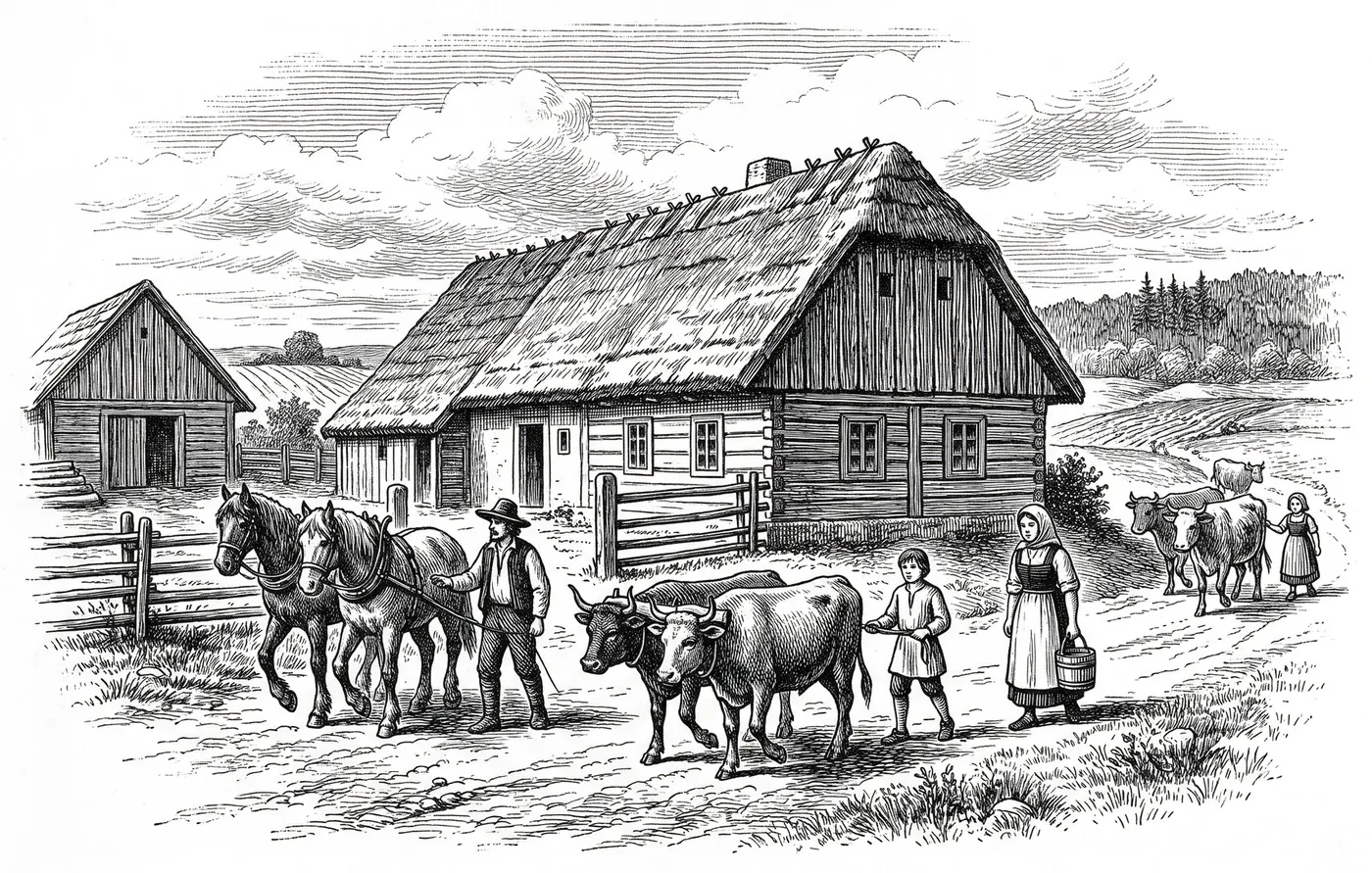
In Rtyně the farmers Urban and Matouš Nývlt worked their land. Matouš kept four servants, Urban three; only a small share of the farms on the estate employed that many. In Svatoňovice, thirty-year-old Martin Nývlt lived with twenty-year-old Dorota on a farm with a groom for the horses, a driver’s boy, a maid and a girl who herded the cattle. Only four farming households in Svatoňovice had four servants.
Martin Hejna in Havlovice also kept a large household of servants. Thirty years later his daughter Eva married Martin Nývlt, son of the Martin of Svatoňovice. The marriage joined two farming families from neighbouring villages.
The oldest of the Rtyně Nývlts was Urban. In 1651 he lived with Marjána, his grown son Václav and his daughter Marjána. According to the record Urban was seventy and Marjána thirty-nine. Ages were often written down approximately, yet the gap between husband and wife is striking.

III.
The rychta at Rtyně
The rychta combined a large farm, an inn and the village office. The reeve allotted the labour owed to the lord, collected dues, settled small disputes with the aldermen and spoke for the village before the lord. The reeve of Rtyně was also a freeman, and the office belonged to a hereditary farm. With a hundred korec of fields, the rychta was the largest holding in the village at the start of the eighteenth century. According to local tradition the Nývlts had held it since 1565.
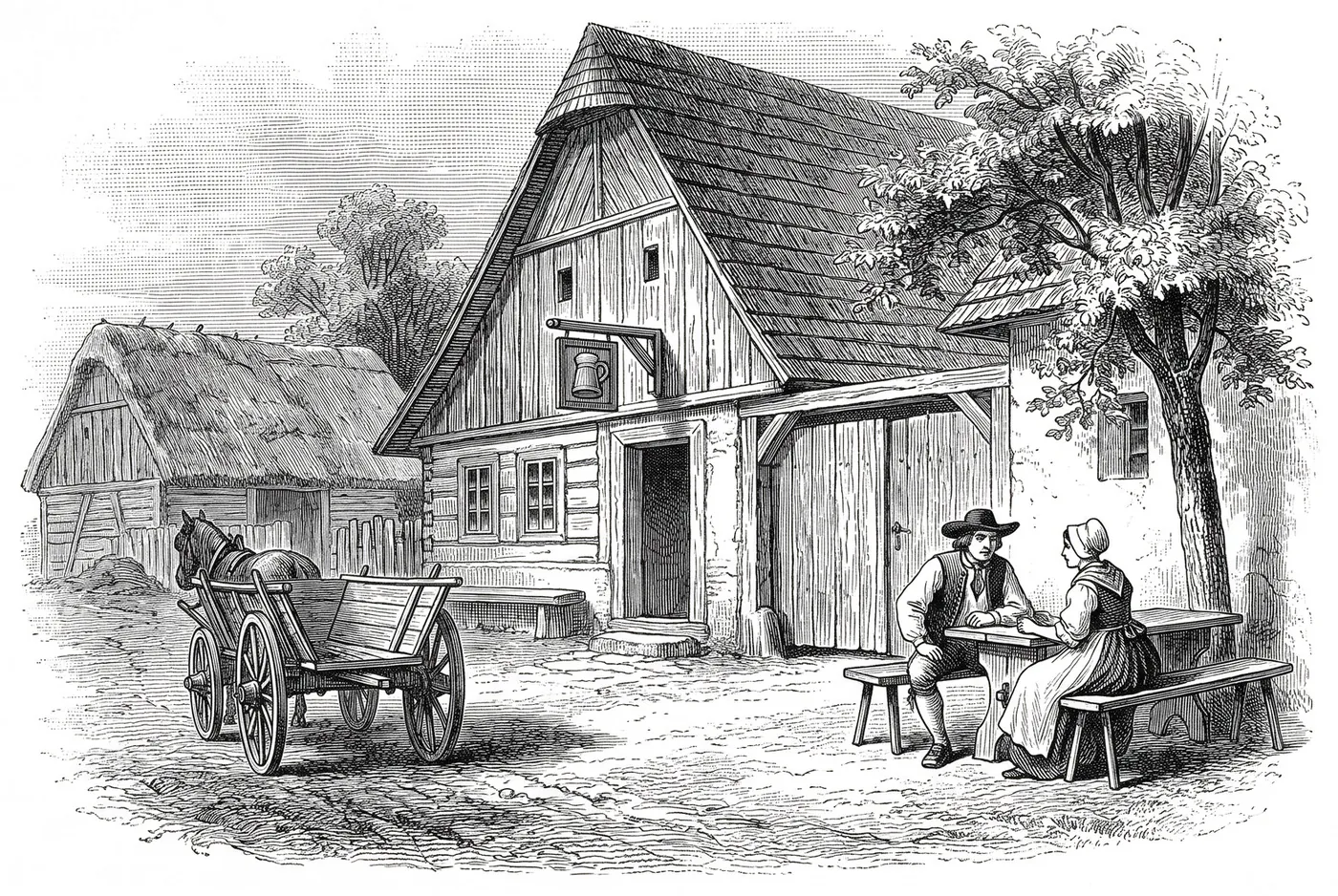
In 1694 the rychta was taken over by Jan Nývlt, by then a father himself. His son Jan Jiří was the father of Antonín Nývlt, the future leader of the revolt.
For several generations the Rtyně Nývlts were bound to the Prouzas, holders of the second-largest farm in the village. Prouzas stood godparent to their children from the mid-seventeenth century until Antonín’s baptism in 1727. They appear as godparents to the children of Jakub, Václav and Jan Nývlt.
IV.
The retirement contract
1728
Jan Jiří took over the rychta only after he turned forty. After marrying Dorota Kloudová in 1714 he farmed a smaller holding of twenty-four korec. The rychta stayed with his father. It changed hands only at Epiphany 1728, when old Jan was about seventy and Jan Jiří forty-one.
Jan Jiří was to pay six hundred kopy of Meissen groschen for the rychta and another hundred and twenty for the garden, about eight hundred and forty florins in all. For comparison, a farm in Rtyně had sold a few decades earlier for four hundred kopy, and a cottage in nearby Havlovice for seventy. With the rychta Jan Jiří took over six milk cows, two heifers, a bull, two calves, thirty sheep, two goats and a pig.
The first two instalments were to come to two hundred kopy; the rest was to be paid at twelve kopy a year. At that rate the payments would have taken more than forty years. They covered his father’s debts and older claims charged on the rychta.
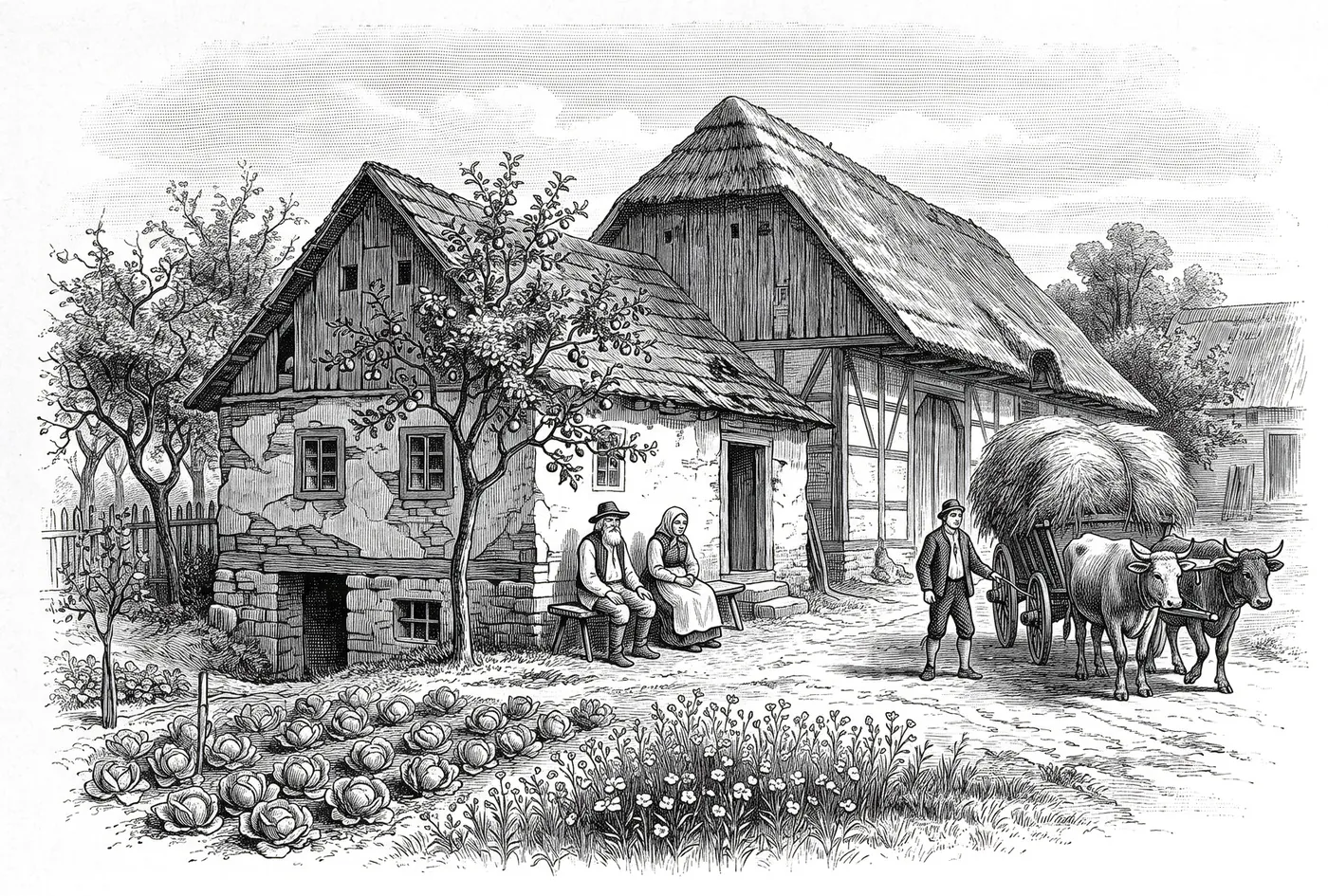
Old Jan set out his retirement precisely. He and his wife could live in the little cottage above the cellar and use two storerooms. Every week he was owed a loaf of bread, and firewood as needed. He chose a piece of field, two beds for cabbage, a patch for flax, a small garden below the barn and the orchard under the windows. Of the harvest, three cherry trees and a quarter of the apples and pears were his. His son was to graze and feed his cattle at his own cost and deliver him a wagon of hay every year. Jan Jiří was also to help his brothers with firewood from the rychta’s woods.
Two generations then lived side by side at the rychta, each with precisely defined rights. The son took the land, the livestock, the debts and the running of the rychta. The father kept his lodging, a piece of field, his own cattle and an exact share of the harvest.
Jan outlived the handover by seven years. When he died in 1735 he was, according to the record, seventy-eight. His funeral had a sermon and four requiem masses; that spring no other adult buried in the area had more than one.
VI.
The fire
1747
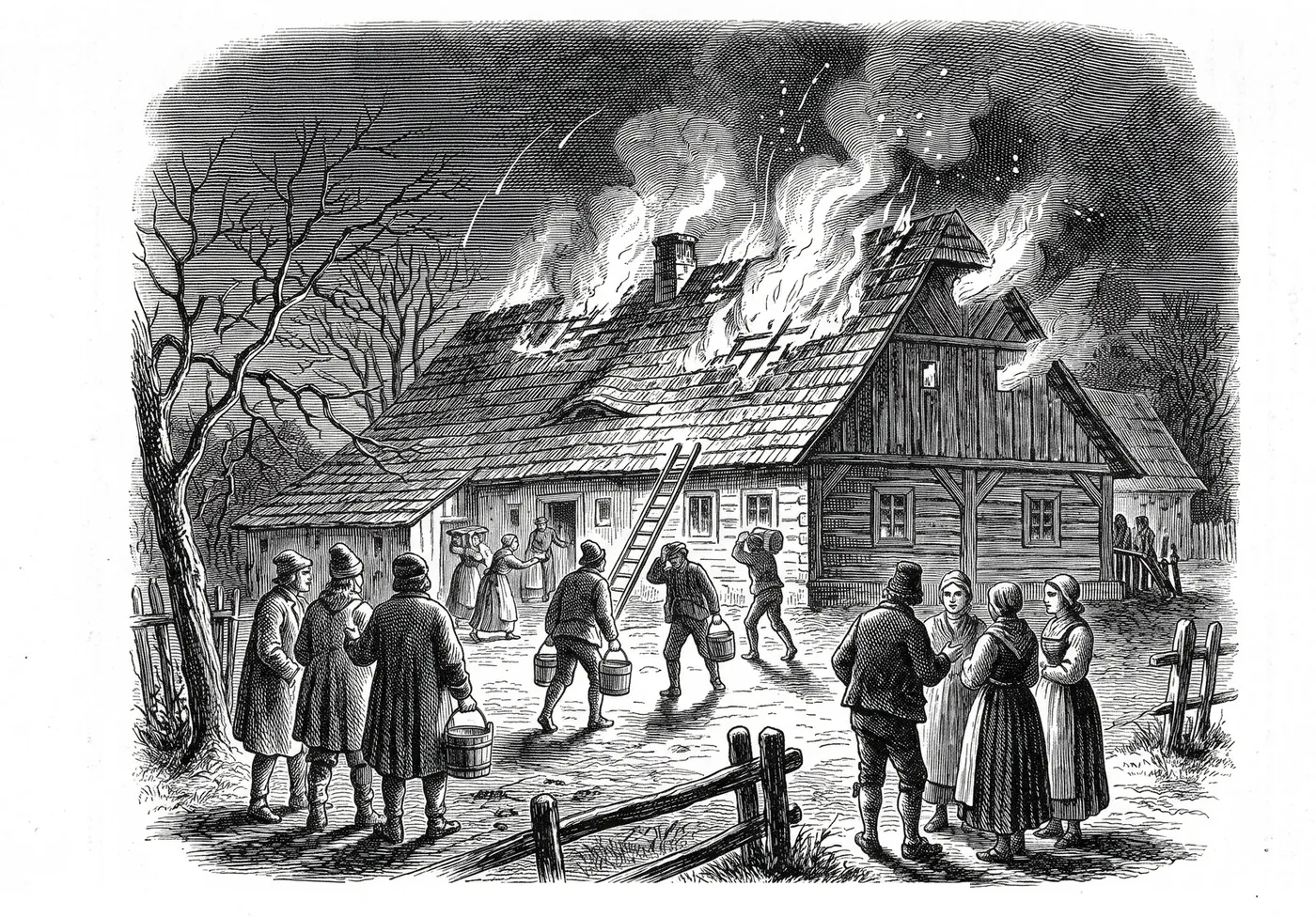
On All Souls’ Day 1747 fire swept through the rychta at Rtyně. Jan Jiří, sixty-one, tried to save his property and died in the burning building. What remained of his body, bones and entrails, was laid in a small coffin and buried two days later after a sung mass in the churchyard of St John the Baptist. The old charter of privileges, issued to the reeve of Rtyně in 1456 by George of Poděbrady, was also carried out of the rychta. The fire left its marks on it.
The youngest son, Jan, had been born in June that year; he was four months old at the time of the fire. After Jan Jiří’s death Dorota was left with twenty-year-old Antonín, ten-year-old Josef and the baby.
The office of reeve passed to Antonín’s uncle Matěj; the farm stayed with the widow Dorota. The very next year a new rychta, built of stone, began to rise on the burnt site. In 1750, with his relatives’ consent, Antonín took it over from his mother. Debts of eight hundred and seventy-five florins were then charged on the rychta, roughly the whole purchase price at the previous transfer in 1728.
Antonín was twenty-three. The contract also provided money for his clothes and wedding, and his wife Alžběta’s dowry of more than three hundred florins. He became reeve in 1755. At twenty-eight he held the largest farm in the village, ran the inn and spoke for Rtyně before the lord.
VIII.
Leader of the revolt
1775
In the early 1770s harvests failed in the villages below the mountains. In 1770 the spring snow lay until the end of April and damaged the sown fields; the next harvest was worse still. Within two years the price of rye around Úpice rose from one and a half florins a korec to twelve, and to as much as sixteen nearer the mountains. About three times as many people died as in ordinary years. In 1774 the labour dues began to be revised, and word spread among the subjects of an imperial patent that abolished them and that the lords were said to be hiding.
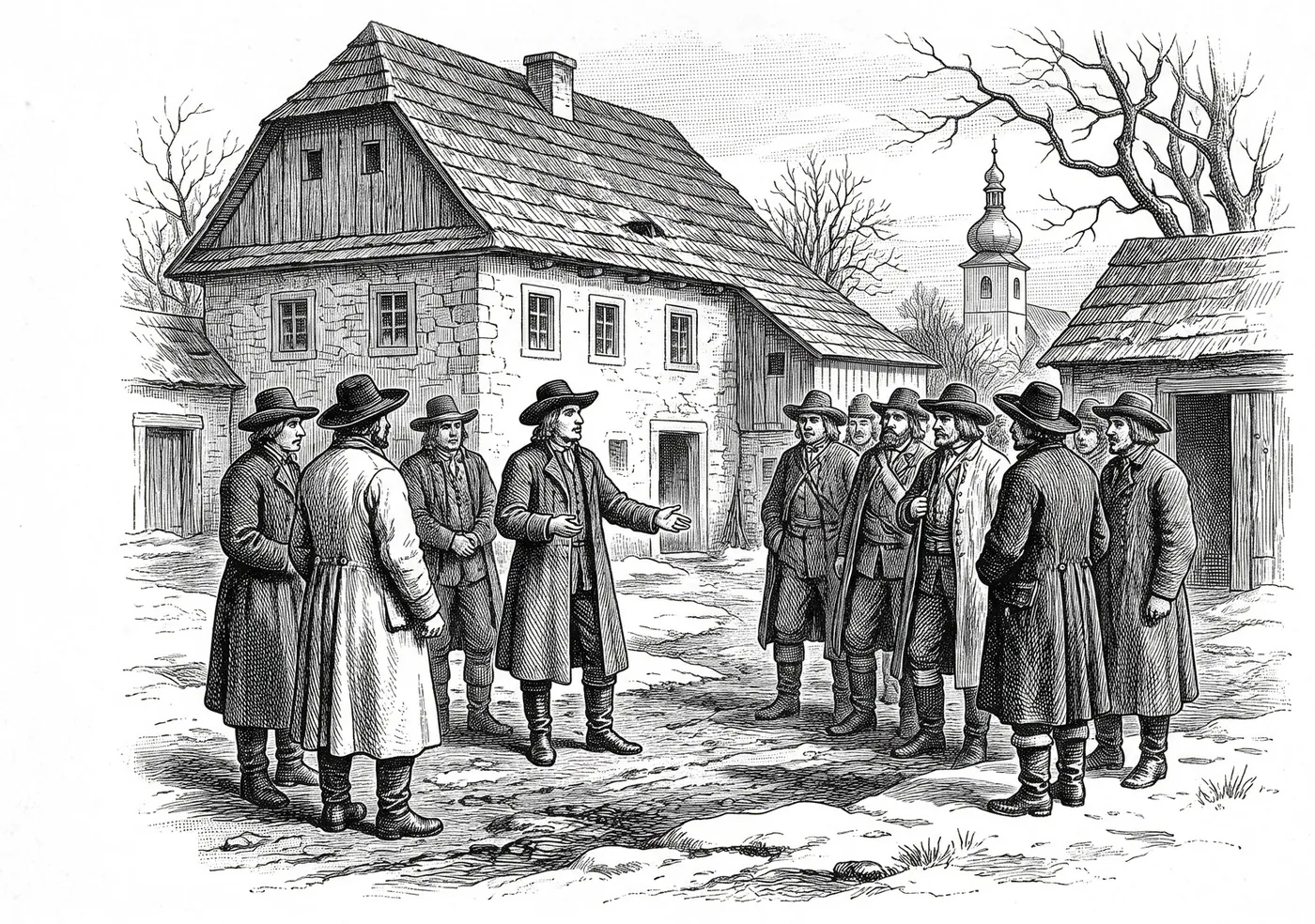
In the spring of 1775 farmers began to gather at the rychta in Rtyně. It was the largest holding in the village, an inn, and the seat of a reeve who had spoken for Rtyně before the lord for twenty years. Reeves and leading farmers gathered around Antonín and formed a council they called the guberno. His contemporary Josef Houser called him “the foremost leader of the risen people”.
On 19 March they agreed at the rychta to go to Náchod castle. After several days of negotiation they won a provisional settlement from the lord’s officials: a landed subject would owe one day a month of labour with his team and six days a year of manual work, a cottager two days a year. The guberno also sent instructions to the surrounding villages, and the Náchod settlement spread to neighbouring estates.
During the night before 28 March a cavalry detachment under Second Lieutenant Josef Reis reached Náchod. That day Antonín came to the castle with his councillors, and by evening all of them had been arrested. Reis recorded Antonín’s words that the guberno would not give up any of its demands, “for they are the masters now, and they give the orders”.
Antonín was taken through Hradec Králové to Prague. Úpice tradition preserved a report of a death sentence commuted to two years of public labour in the streets of Prague. He lost the office of reeve, and the lord installed his cousin Klement in his place. The farm remained his. He died at the rychta in Rtyně in 1782, aged fifty-five, as a farmer. His descendants held the rychta until 1901.
IX.
The Dutch legend
By the early twentieth century the Rtyně Nývlts had a family story of their own. In 1901 a Náchod newspaper compared Antonín to Kozina, the Chod rebel, and called him “the chief leader of the struggle to free the country people of the Náchod region from bondage”. A memorial plaque “from grateful descendants” had been set into the rychta, and according to the paper the family still kept “a precious distinction granted to this family by the kings of Bohemia”. In 1924 Lidové noviny noted that the direct line of the Rtyně reeves had died out with Theodor Nývlt, and added a new element: “The family comes from Holland.”
Older accounts show the Nývlts as a prosperous farming family. In his little book on the Svatoňovice spring, Antonín’s uncle David Antonín Nývlt, an official at Náchod castle, knew the knightly and noble families that had once lived in the Náchod region, and linked several of them directly with Rtyně. He did not count the Nývlts among them. The reeve of Rtyně had the standing of a freeman: his hereditary farm was exempt from labour dues, and the reeve’s office went with the holding. A song about the uprising, composed around 1790, could therefore present Nywelt of Rtyně as “a neighbour of good birth”. The word does not in itself prove noble descent.
The form of the surname may have fed the Dutch legend. Czech texts wrote Nywelt or Nywolt; books kept in German wrote Niewelt or Niwelt. A military report of March 1775 knows Antonín as “Gouverneur Niweld Richter von Herdina”: Nývlt, reeve of Rtyně. The form Niewelt could then tempt people to look for the same or similar names abroad.
As late as the mid-twentieth century people in Rtyně said the Nývlts had come from Holland. In 1954 Antonín Vorlický linked this tradition with the older form Niewelt and with the Dutch writer van Nievelt. Vorlický thus looked for the family’s origin in Holland, yet the earliest Nývlt he named, Jíra, he brought to Rtyně from nearby Radeč near Úpice.
Later family histories embroidered the story further. Gaspar van Niewelt was added, with Dutch knightly descent, a castle and a coat of arms. The freeman of Rtyně became a baron. Gaspar was also given the Czech name Kašpar Nybl. Yet the name Kašpar appears in the area as early as 1562, when Mikeš Zeman bought the Maršov rychta “from Jíra Nybl (Kaspar)”. Among the known Nievelts of the late medieval Netherlands we have so far found no one who could be linked with the Nývlts of Rtyně. Jasper, the Dutch form of Kašpar, first appears in the van Zuylen van Nievelt family in 1751.
The surname Nývlt can also be explained without a Dutch origin. It is derived from the German Neuwelt or Niewelt, “new world”, which settled into the Czech form Nývlt. The Krkonoše hamlet of Nový Svět was founded only after the earliest known records of the surname in this area. The earliest known Nývlts are found around Úpice and Rtyně, and in this countryside the Nývlts went on living for centuries.